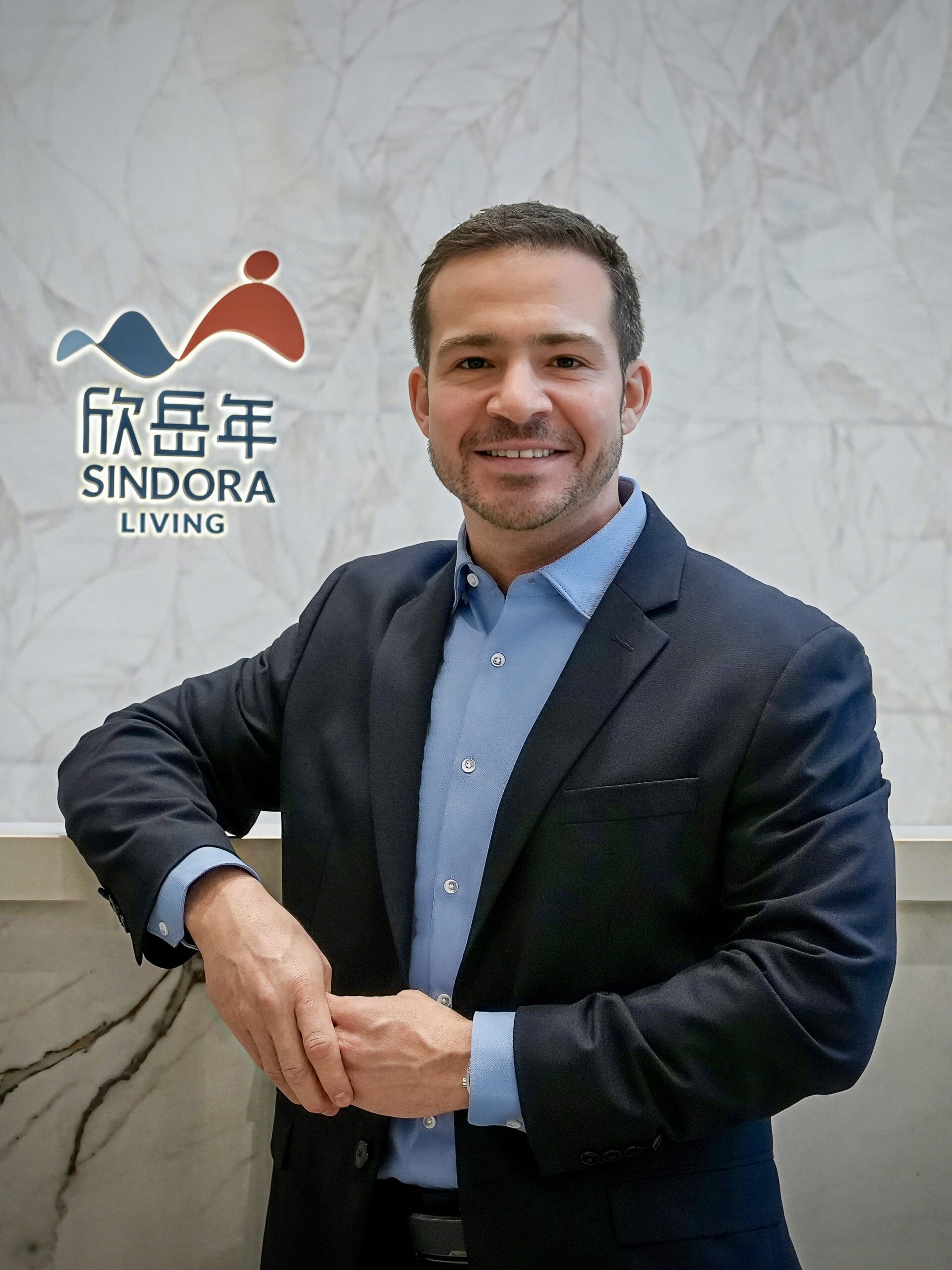
Building, operating and scaling senior living and eldercare platforms across Asia.
I’m Nathaniel Farouz (高天禮), a French-born business operator with close to two decades of operating experience across Asia. My work focuses on building senior living and eldercare platforms that bring together investment, strategy, operations, care, hospitality and technology.
Today, as CEO of Sindora Living and CEO of Senior Living Asia at Keppel, I bring those disciplines together in operating models designed to scale, remain economically durable and preserve what makes care worth providing: quality, agency, purpose and human connection.
Anthropology sharpens how I read culture, family structures and lived experience within those systems. Photography is another form of attention, and a personal passion.
Explore by topic
Latest publications
At 92, Mrs Ma is learning AI and already planning her next attempt
👵 At 92, Mrs Ma taught herself how to create TikTok-style animated videos. Then she entered into a competition, but did not make the shortlist. Yet, she immediately decided to learn from the winners and try again next year!
✨ This is what “Live on your own terms” means to us: continuing to learn, create, take risks, and pursue your own ideas, whatever your age!
🧭 Our role is not to decide how residents should spend their time. Our mission is to give older adults the freedom, tools, and support to keep writing their own stories, whether that means coaching, tutoring, therapy, healthcare, or cognitive support. Whatever helps each person continue living on their own terms!
👏 Very proud of Mrs Ma, and of the Sindora Living team supporting her!
📰 Thank you to Xinhua News Agency and Jiaohuidian News for sharing her story at Sindora Nanjing. For the full article in Chinese: read it here.
First published on LinkedIn, October 26, 2026. View the original post.
Sindora Foshan is already coming to life
Sindora Foshan (欣岳年佛山国际颐享家园), our new senior living community developed in partnership with Ping An Insurance…
Still under construction, but already coming to life thanks to its future residents, their children and grandchildren. And the horses too! 🐴
More soon…
First published on LinkedIn, October 23, 2026. View the original post.
Twenty years in Asia: chance, firsts and blank pages
🎂 Today marks exactly 20 years since I began my professional life in Asia.
Looking back, I don’t see a master plan, but a few encounters and decisions that seemed almost insignificant: choosing Chinese almost at random at Sciences Po; someone at Lafarge giving me a chance even though my Mandarin was far below his expectations; casually telling a friend “I’m bored at work”; arriving late at that dinner where there was only one seat left… None of these moments felt particularly important at the time. Together, they changed the direction of my life.
🚪 They opened doors, but I still had to walk through them, usually without knowing what was on the other side. Again and again, I found myself facing a blank page: joining an old-school Chinese SOE in a remote area as its first foreign employee, at a time when some factories still displayed “Forbidden to dogs and French” signs; trying to recover energy from waste at scale before “circular economy” was part of everyday business language; entering senior care when many people insisted that the concept was culturally irrelevant in China… I can proudly say that I have collected a few “firsts”. But most of the time, being first meant having no roadmap, making mistakes, and continuing while perfectly reasonable people explained why it wouldn’t work.
📷 My camera also took me far beyond work, into villages, markets, and rituals across Yunnan, Sichuan, and many other parts of Asia. Photography taught me to pay attention. Anthropology helped me question what I thought I understood.
🇨🇳 Over those twenty years, I watched China transform. I saw skylines rise, high-speed rail collapse distance, cash give way to QR codes, geopolitical relationships shift, and local companies become global leaders.
China transformed me too. It taught me patience, resilience, and, when faced with the absurd, to choose humor and candor over anger. I came to Asia to build a career, and I did. But I also built friendships, teams, and communities. I collected stories and faces (and hats!). Some people I first met as colleagues became my closest friends. Most importantly, I built a wonderful and supportive family, one that has made every place feel like home.
Looking back, I think a life is shaped by both the small decisions and encounters that change its direction, and the decision to move forward when the page ahead is still blank.
So I try to stay open to accidents, give others the chances I was given, and not wait for certainty before starting.
谢谢中国. Thank you, Asia!
First published on LinkedIn, August 31, 2026. View the original post.
Longevity science works at every age
Longevity science is everywhere right now (and so is the hype!).
But turning scientific findings into something practical, effective, and scalable is much harder. Truly evidence-based advances remain rare.
There is also a widespread assumption that longevity medicine is mainly for people who are still young, healthy (and wealthy) enough to “optimize” themselves.
Our team has just demonstrated the opposite.
This week, a scientific poster presenting a real-life study conducted with our residents was displayed at the Proactive Health and Ageing International Forum in Hong Kong, and our research received the Asian Geriatrics Youth Paper Award.
At Sindora Nanjing, we used scientifically grounded longevity tools with residents aged 70 to 95, averaging 88. We translated the findings into personalized plans covering nutrition, exercise, sleep, and rehabilitation.
And it works: we can use science at any age to help people preserve mobility, autonomy, choice and control over their own lives.
We are now expanding this approach into our new communities. We will keep measuring, researching, and improving it as we learn.
Very proud of Jacqueline Ong, Lisa Xu Wenying and the whole Sindora Living team. Thank you to LiveBeyond, Professor Brian Kennedy and Dr Chong He for their partnership and scientific support!
Longevity should not remain a privilege for the young. It should improve the lives of the people who need it most.
First published on LinkedIn, August 26, 2026. View the original post.
The best interventions do not feel like interventions
These uncles and aunties are going to put me out of a job. 😅
If you want to be amazed, watch the video!
At Green Lake in Kunming, I found seniors exercising, dancing, singing, playing music, and walking with their pets, with more energy than most people I know (one of them humiliated me at pushups).
It would not occur to anyone watching them to call any of this “therapy.” But with my professionally biased mind, I cannot help seeing physical exercise, pet therapy, music therapy, and dance therapy.
Maybe that is the takeaway: the best interventions do not feel like interventions.
They feel like a normal morning, a reason to leave home, friends who notice when you do not show up… fun!
Back in our senior living communities, this is precisely the challenge: organizing interactions that do not feel too organized.
You cannot manufacture spontaneity, but you can create the right conditions for it.
That philosophy should guide everything: staff training that enables rather than directs; architecture and layouts that encourage encounters; services that create opportunities, not just activity schedules; and residents who can initiate, contribute, and lead.
A lively community is not one where staff organize everything: it is one where residents start organizing themselves.
If these uncles and aunties represent the future of aging, perhaps our job is to create the conditions for them to put us out of a job. 😄
First published on LinkedIn, July 20, 2026. View the original post.
Learning for its own sake: completing my Harvard degree
🎓 "We refuse to let the current version of our lives be the final version."
That sentence from the Harvard Extension School Commencement speech has stayed with me.
A month ago, I attended my Harvard University graduation ceremony for a Master's in Anthropology & Archaeology, my third master's degree. I started it during the COVID lockdown… "for fun." Somehow, that also ended with a place on the Dean's List for Academic Achievement.
🗿The truth is, I never completely got over wanting to be Indiana Jones. Most people eventually outgrow that dream. Mine simply evolved into ethnographic fieldwork in the foothills of the Himalayas, dozens of academic papers, and considerably fewer ancient temples and cracks of the whip than I'd been promised.
And yes, despite the all-nighters, the flights spent reading and writing, and the privilege of living alongside isolated tribes in the mountains of China, it genuinely was fun!
I've always believed that learning doesn't need to be justified. Not every pursuit has to make you richer, faster, or more successful. In this case, learning for the sake of learning was reason enough. Curiosity is one of the few investments that always changes the person making it.
Ironically, this degree "for fun" ended up making me better at my job too. Anthropology didn't teach me how to operate senior living communities, but it deepened my understanding of the people we serve. Different discipline, same questions: how people adapt when their world changes, what traditions they preserve, which ones they reinvent, and how communities continue to thrive across generations. I never expected those synergies, but I'm grateful they found me.
Perhaps that's the real value of learning. You rarely end up exactly where you expected, but if you stay curious enough, you almost always end up somewhere worth being.
Thank you to Chanelle Ohayon-Crosby, Oriana, Jonas, my friends and colleagues for patiently putting up with countless "just one more paper" and "sorry, I can't, I have a deadline." I know I probably tested your patience at times. I hope I've made you proud!
Thank you to my professors, especially Prof. Joe Henrich and Dr. Richard Martin, who constantly challenged me intellectually.
Here's to refusing to let the current version of ourselves be the final one… and to chasing a few more childhood dreams along the way. 🎩
Credit for the commencement quote: Theo Rowley.
First published on LinkedIn, June 30, 2026. View the original post.