Good intentions do not operate a care business. Neither do a beautiful building, a demographic forecast or a compelling brand. A senior living platform works only when hundreds of decisions about capital, design, staffing, training, technology, partnerships and culture reinforce one another every day.
That is why I see operations as the place where a promise becomes a lived experience. The goal is to standardize what must be reliable without standardizing people; to use technology to return time and attention to caregivers; and to build economics strong enough to protect quality over the long term.
I write here about what it takes to turn a concept into a durable platform, including the systems that work, the assumptions that fail and the trade-offs that cannot be solved by slogans.
Cases, systems and operating notes
-
Senior living
Longevity cannot be built quarter by quarter
🤷🏼♂️Deutsche Bank just put Sindora Living 欣岳年 in the same list as Apple.
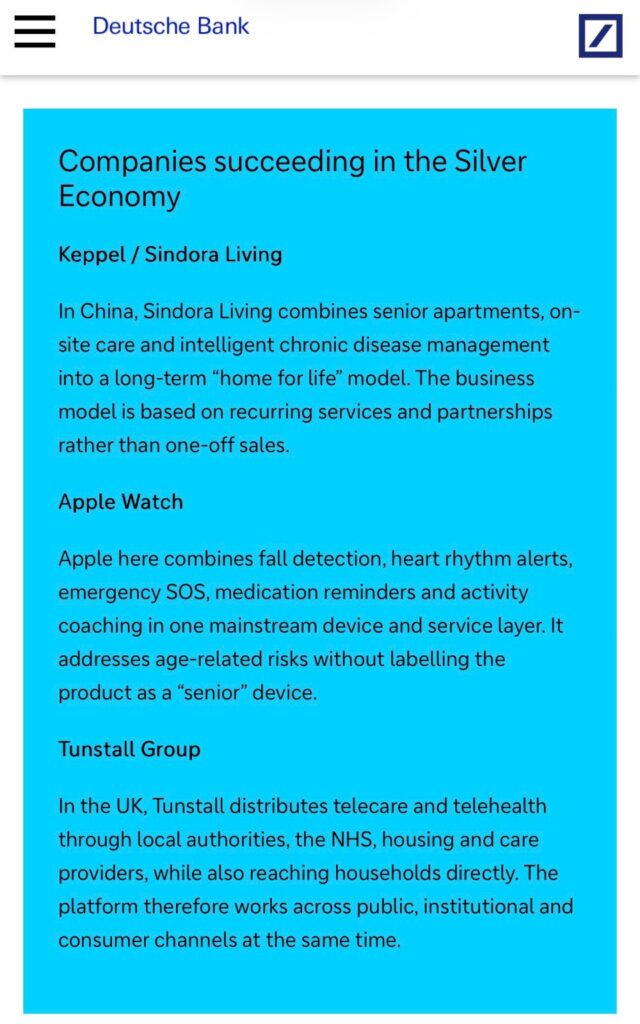
One of us is worth $3 trillion, the other manages senior living communities in Asia. I’ll let you guess which is which 😂.
Jokes aside, it’s gratifying to see Deutsche Bank recognize a model we believe strongly in: senior living built around long-term relationships, recurring services, and genuine care rather than one-off real estate transactions.
After all, longevity is, by definition, a long-term business. It cannot just be built quarter by quarter. It requires relationships measured in years.
The article makes it clear: the Silver Economy isn’t coming, it’s already here, and China is poised to become one of its leaders. Nice to see Sindora included in that conversation.
Read Deutsche Bank’s report on the Silver Economy.
First published on LinkedIn, June 19, 2026. View the original post.
-
Senior living
AI will automate tasks, not presence
🤖 AI just declared senior living safe from disruption. My reaction wasn't relief.
Anthropic, the company behind Claude, just published a landmark study mapping which jobs AI will automate next.
Computer programmers: 75% of tasks covered. Customer service reps: 70%. Data entry: 67%.
Caregivers, nurses aides, care home staff: 0%.
I've spent 13 years building senior care platforms across Asia. And when I saw that number, my first thought wasn't "great, we're protected." It was: if our people are irreplaceable, why is it still so hard to convince talented people that care is a career worth choosing? Because here's what low AI exposure actually means in our sector. It doesn't mean low pressure. And it doesn't automatically translate into recognition, status, or career desirability. Society has a long habit of undervaluing the work it cannot replace. That's the real problem we need to solve.
Now flip it the other way.
The back office of senior care, documentation, scheduling, compliance, staffing logistics, is highly exposed to AI. That's exactly where we should be deploying it. Not to cut headcount. To return time to the people whose work no algorithm will ever replicate.
And there's one more thing the study hints at, that nobody in our sector is talking about. Millions of educated, higher-paid white-collar workers may face real disruption in the next few years. Some will need to reinvent entirely. Care is one of the few fields that will remain structurally, irreducibly human.
That's not a consolation prize. That could be the most meaningful redeployment story of the next decade, if we make care a profession people actually want to enter.
AI will automate the task. It will never automate the presence.
So here's my question: is caregiving undervalued because it's hard to automate, or is it hard to automate because it's been undervalued? Anthropic’s full study is worth reading even if senior living is the last thing on your mind — especially then.
First published on LinkedIn, March 9, 2026. View the original post.
-
Senior living
Can AI help cities age better?
🏙️ Can AI help cities age better?

On 6 March, I’ll be speaking at the Intelligence Outlook Forum 2026, organized by SPARK.
This year’s theme, “The AI Operating System for Future Cities & Flourishing Human Vitality”, feels particularly relevant.
If cities are becoming intelligent systems, senior living and healthcare are not peripheral layers. They are central.
The real question is not whether AI will be embedded in our cities. It is whether we design it to strengthen autonomy, dignity, and human agency.
Looking forward to the conversation.
First published on LinkedIn, February 27, 2026. View the original post.